Distortion sits at the intersection of physics and production reality. Heat goes in, metal expands, welds solidify, and then everything shrinks while the surrounding material resists. If you build to print for tight-tolerance assemblies or you run a busy metal fabrication shop feeding a cnc machining shop downstream, welded parts that move a few millimeters can become a week of rework. The cure is not a single trick. It is a layered approach across design, process planning, fixturing, sequencing, welding parameters, and sometimes postweld processing. The best welding company teams do most of the work before striking an arc.
I have spent years inside Canadian manufacturer facilities and mixed-use manufacturing shops that serve industrial machinery manufacturing, food processing equipment manufacturers, logging equipment, Underground mining equipment suppliers, and biomass gasification projects. The parts change with the industry, yet the physics do not. Whether you are a steel fabricator building custom machines or a cnc metal fabrication department supporting an Industrial design company, the following techniques form a practical playbook to control distortion while keeping productivity and cost in check.
Why distortion happens and why it gets worse
Welding introduces a localized heat source with steep temperature gradients. The molten pool and heat-affected zone expand, then contract as they cool. Shrinkage is greatest along the weld axis and through the thickness, which explains angular distortion, longitudinal and transverse shrinkage, bowing, and buckling. Thinner sections, austenitic stainless, and aluminum typically distort more than thick low-carbon steel. Larger weld deposits, high heat input, and unbalanced weld placement magnify the problem.
Distortion worsens when the part lacks restraint, when sequence fights the geometry, or when fit-up requires gaps that must be bridged. On multi-process builds, you can also stack distortion by moving between stations without normalization or because downstream machining reveals latent stresses. A cnc precision machining cell can hold microns on the vise, but it cannot rescue a frame that is banana-shaped.
Start at the drawing: build to print without inheriting distortion
Controlling distortion begins with design-for-weld. On build to print jobs, influence might be limited, yet good manufacturers feed suggestions back to the customer or the Industrial design company.
- Choose joint types and preparations that minimize volume. For example, a double-sided partial penetration with a narrow land can outperform a single deep V from one side. If a double bevel is possible, you can halve the deposited metal and cut angular distortion significantly. Consider joint placement and symmetry. Place welds along the neutral axis when possible and mirror welds to balance shrinkage. A box weld on only one side of a web invites a twist.
Stiffeners and ribs help, but they can lock in stress or cause local buckles when continuously welded end to end. Slot welds or intermittent welds, specified with clear patterns, often carry the load with far less heat input. If the structure is destined for precision cnc machining, add machining allowances in distortion-prone zones and consider sacrificial tabs for fixturing. These cost little and save hours later.
Material selection matters as well. Low carbon steels with predictable coefficients of expansion and mild hardenability behave better than high-strength quenched and tempered plates, which can introduce residual stress and require preheat. In a custom metal fabrication shop with mixed materials, keep different alloy families separated in the same assembly if you can. Unequal shrinkage across a stainless-to-carbon interface can twist a panel even when weld size is conservative.
Fit-up and gap discipline
Distortion correlates with deposited metal, and gaps force you to pour in filler. When a production team is chasing schedule, it is tempting to close your eyes to a 2.5 mm mismatch. That gap will cost you twice, once during welding and again during straightening or machining. Invest in repeatable fit-up.
On plate frames, use tack bars, back-step tacks, and chill blocks to keep edges flush. Dress bevels consistently, remove mill scale in the weld area, and use clamps that apply force near the joint rather than far away where they flex the part. For repeat runs, machine hard stops into your fixture for datums A, B, C and verify with feeler gauges. On tubular structures, cope joints accurately, then use mandrels or internal plugs to hold roundness. The goal is to keep tacks small but frequent. Replace the habit of three large tacks with six to eight smaller, opposing tacks that distribute restraint evenly.
In our cnc machine shop partnership builds, we often program a quick skim face on critical mating surfaces prior to welding to reduce fit-up stress. It looks like extra work, but it keeps the weld volume down and makes the postweld machining light.
Fixturing that actually restrains without creating a pretzel
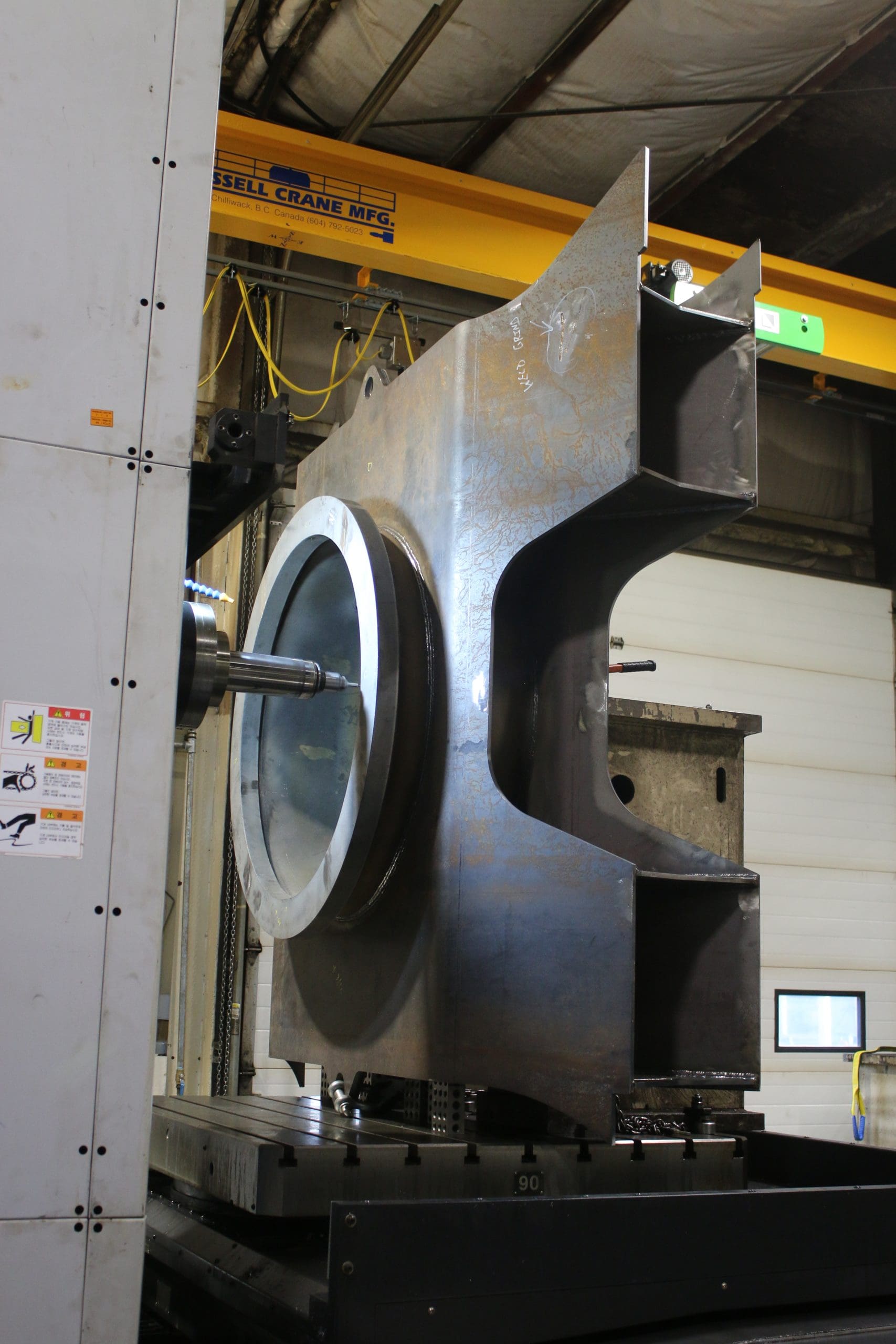
A fixture is not just a table and clamps. It is the engineered restraint that anticipates shrinkage vectors and either blocks them or preloads against them. Good fixtures are rigid where they need to be, compliant where they can be, and they provide ample access for torches and guns. For large mining equipment manufacturers, we build modular fixtures on 28 mm or 16 mm grid tables with precision locators, dog-bones, and toggle clamps. Repeatability allows tighter sequencing and less variability.
Pre-bending or presetting is a subtle but powerful technique. If you know a 2-meter beam will close by 2 mm after welding, set it proud by 2 mm in the opposite direction. This is easier on simple geometries, but with measurement data and a few trials, you can build consistent offsets. A fair warning: do not overconstrain. If the part is locked in six degrees of freedom at too many points, shrinkage will find the weak link and dimple a flange or pull a hole out of round.
Thermal mass can be your ally. Heavy copper or aluminum backing bars act as heat sinks and also support the root. On thin stainless skins for food processing equipment manufacturers, we sometimes run water-cooled copper shoes behind the seam to wick heat out, which flattens the bead and keeps discoloration minimal.
Sequence like you mean it
Order matters. Weld sequence can halve or double distortion on the same part. The classic backstep technique applies small welds opposite the direction of progress, so shrinkage incrementally counteracts previous pulls. On frames, weld from the center outward to push stresses to the free ends. For multi-pass bevels, balance beads side to side instead of stacking all passes on one face before turning the part. If weld access permits, alternate opposing sides while the joint is hot so that waves of shrinkage cancel rather than accumulate.
On box sections or closed shapes, do not weld the last side continuously without relief. Stagger short beads and allow venting to manage pressure and minimize collapse. When building large bases for manufacturing machines, we often stitch, stress relieve locally with heat blankets, then close the seams that lock in geometry. It takes discipline and sometimes more setups, but it beats the spiral of heat, pull, re-tack, and chase.
There is also a production cadence element. If multiple welders attack the same assembly, coordinate their arcs. Two people welding long beads on adjacent sides at once may look fast, yet the thermal gradient can twist the part. Rotating between assemblies and giving a hot section time to equalize can also reduce cumulative distortion.
Process choice and heat input control
Process selection is a lever. Gas metal arc welding (GMAW) with solid wire and spray transfer delivers high deposition, but it also pours heat into the joint. Pulsed GMAW lowers average heat input while maintaining productivity, and it usually reduces spatter and clean-up time. Flux-cored arc welding (FCAW) with gas-shielded wire excels for out-of-position welds and can run colder than spray transfer. Gas tungsten arc welding (GTAW) produces beautiful control on thin sections and stainless, albeit slower, though modern pulsed GTAW narrows the heat-affected zone.
For the same joint size, you can reduce distortion by optimizing amperage, voltage, travel speed, and wire feed. A common mistake is oversizing the weld. If the print calls for a 6 mm fillet, many welders err on the side of a 7 or 8 mm leg, adding 30 to 70 percent more metal than necessary. A fillet gauge pays for itself in an afternoon. Travel speed deserves as much attention as current. Too slow, and heat soaks the surrounding plate. Too fast, and lack of fusion invites rework that requires more heat tomorrow.
Preheat and interpass temperature control reduce cracking risk in higher strength steels, but they also increase heat input and potential distortion. Use the minimum preheat that meets the welding procedure specification and measure interpass temperatures diligently. On heavy flanges, intermittent cooling with compressed air between passes can be helpful, but quenching with water is generally a bad idea. Uneven, rapid cooling can lock in stress and cause hard zones.
Metal-cored wire can be a sweet spot for plate work in a custom steel fabrication setting. It often allows lower volts for the same deposition, good wetting at the toe, https://waycon.net/capabilities/contract-manufacturing/ and reduced distortion compared to solid wire at spray. For production brackets and repetitive weldments in metal fabrication shops, standardizing on metal-cored wires sized to the common joint thickness simplifies parameter control.
Balance weld size with structural need
Engineers specify weld symbols with intent, but field realities and safety culture lead teams to oversize as insurance. Standardize a practice of asking for clarification or proposing alternates when a joint looks overbuilt. On one logging equipment frame, changing a continuous 8 mm fillet on 6 mm gussets to a 6 mm intermittent pattern with 50 percent weld length reduced total weld volume by roughly 40 percent. Distortion dropped, and the part measured flat without thermal straightening. Fatigue life remained acceptable because the load path was short and the gusset stiff enough.
Encourage your qc and design partners to allow balanced joint design. Doubler plates with plug welds and smaller perimeter fillets beat giant perimeter fillets alone. Where fatigue demands full penetration groove welds, consider backing bars and balanced multi-pass sequences that do not favor one side of the web.
Tack weld strategy and removal
Tacks do more than hold parts together. They counteract pull. Use tacks as mini welds located opposite each other along a seam to share shrinkage. Keep tacks small and fused thoroughly to avoid inclusions, then grind them out or consume them during the final pass. If tacks are left on the toes, they can act like hard spots that concentrate stress. For cosmetically important equipment such as food-grade skids or polished stainless covers in metal fabrication Canada markets, the finish time saved by neat tacks is real.
On thick bevels, stitch tacks across the groove at intervals and back-gouge after the root. This resists land closure and keeps the groove width consistent, which stabilizes bead size and heat input throughout.
Use of backing, chill bars, and copper shoes
Copper backing bars absorb heat and provide support. For thin sheet or tube, copper shapes like simple angles or saddles help keep form. In cnc metal cutting operations, we sometimes cut dedicated copper or aluminum backers that match complex contours, especially for repeated production welds. If the weld is single-sided and appearance matters, a grooved copper shoe can shape the bead and minimize burn-through.
For stainless and critical carbon steel roots, ceramic backing tapes provide clean root faces without needing to access the backside. They also lower the effective heat input by reflecting heat and constraining the puddle.
Water-cooled fixtures sound exotic, yet they are not complicated. Copper bars with internal channels, quick disconnects, and a small recirculating chiller stabilize temperature in high-duty work, such as long seams on thin panels for custom fabrication of enclosures.
Measurement discipline and data feedback
Distortion control improves when you measure and learn. Use straightedges, feeler gauges, and digital levels during fit-up, not just after welding. For high-value parts headed to precision cnc machining, establish a measurement checkpoint after tacking, after major welds, and after cooling. Log the pulls and compare across batches.
Over a six-month run making base frames for a machining manufacturer, we tracked diagonal changes on a 1.5 by 2.0 meter rectangle. Initial average out-of-square after welding was 3.5 mm. After sequence adjustments, pre-bend of long stringers by 1 mm, and switching to pulsed GMAW for the long fillets, average improved to 1.2 mm with fewer outliers. Not perfect, but consistent enough that the cnc machining shop took only a skim pass rather than a heavy correction, saving 30 to 45 minutes per frame on the horizontal mill.
Postweld heat and mechanical straightening
Even with the best planning, some assemblies need straightening. Thermal straightening uses controlled localized heating with a torch to create expansion and subsequent targeted contraction. Triangle, line, and spot heating patterns can shrink high spots and correct bows. The key is to heat only to the correct temperature for the material class, typically 550 to 650 C for carbon steel, verified with temperature crayons. Overheating creates metallurgical problems. Thermal straightening is an art, and you want your most experienced steel fabricator leading it.
Mechanical straightening with press brakes, hydraulic jacks, or clamps often precedes or complements thermal methods. For heavy plate weldments destined for cnc precision machining, we sometimes build simple jack-screw fixtures that allow incremental correction while measuring. The operator turns screws a quarter turn, checks, and repeats. The measured approach prevents overshoot.
Stress relief through furnace normalizing or localized postweld heat treatment has its place. For thick weldments in mining equipment manufacturers’ portfolios or pressure-retaining components, formal PWHT may be specified. For general fabrications, full stress relief is usually overkill, but a controlled bake at 200 to 300 C can equalize temperature and reduce immediate spring-in, making measurements more stable before machining.
Process control specifics that pay off
Shielding gas composition influences bead shape and heat. For carbon steel GMAW, a 90/10 or 92/8 Argon/CO2 mix in pulsed mode provides tighter control and less heat than straight 75/25 in spray on the same joint. For stainless, tri-mix on short-arc with metal-cored wire can keep heat low and wet the toes nicely, especially on 304 and 316 in thinner gauges.
Stickout and contact tip to work distance matter more than many admit. Excessive stickout raises resistance heating in the wire, softens the arc, and increases heat input per unit length because travel slows. Train welders to keep consistent stickout, and use contact tip recessed or flush positions tailored to the transfer mode. On robotic cells in cnc metal fabrication lines, program approach angles that keep the arc force pushing the puddle into the joint to allow faster travel.
Arc starts and stops add heat and defects. Use run-on and run-off tabs, then remove them. On parts without room for tabs, crater-fill techniques and slight backstepping at the end reduce craters that pull and crack.
Robotic welding and automation considerations
Robotic welding does not automatically solve distortion. It repeats both good and bad choices very efficiently. The advantage is in parameter tightness, consistent travel, and predictable sequencing. When integrating a robot for a cnc metal fabrication production cell, build fixtures with hard locators and integrated clamps that apply force at correct angles. Program balanced sequences, short segments, and interleaved welds where possible. Robots excel at pulsed GMAW and metal-cored applications, which often lowers overall heat input and distortion compared to manual spray.
To manage thermal accumulation on multi-weld cycles, include dwell steps in the program or rotate to a second fixture while the first cools. Thermal imaging cameras or simple infrared thermometers provide quick checks. Many manufacturing shops find that reducing average part temperature by even 30 to 50 C between cycles cuts cumulative pull noticeably.
Material thickness transitions and mixed joints
Where thick meets thin, the thin side becomes the distortion culprit. Use transition joints with buttering passes on the thick component to support a balanced groove and allow lower heat to penetrate the thin piece adequately. On structural tube to thick node plates, partial penetration welds with backing and a designed fillet radius often distort less than forcing full penetration into the thin wall, which can collapse.
If the design uses high-strength low alloy plate, follow the WPS for preheat and interpass religiously. Distortion control that ignores hydrogen control is a false economy. Cracks cost more than any straightening. For a custom machine operating in harsh environments, reliability beats a small gain in flatness every time.
Integrating welding and machining for predictable results
The best distortion control strategy lives across departments. Coordinate with the cnc machining services team before welding starts. Establish stock allowances, datum schemes that survive welding, and preferred clamp zones for the mill or lathe. If possible, perform an intermediate machining step after the heaviest welds while leaving sacrificial lugs for a final clamp. Machine shops hate chasing spring after you remove the last clamp. If they can rough and semi-finish, then return the part for final light welds or stress equalization, the final finish will be stable.
For assemblies that mate to precision equipment, consider reference bores or bushings installed postweld. Precision dowel pins and bored locators can mitigate small residual frame distortion. A cnc machining shop can then reference those bores, not the raw frame edges that may have moved during welding.
Case notes from the floor
A mining chute frame, 3 meters long, 10 mm skins on 20 mm ribs, repeatedly bowed 6 to 8 mm after long seam welding. Original process: GMAW spray, continuous seams, sequence from one end to the other. Changes implemented: pulsed GMAW at lower average heat, intermittent seam pattern per engineering approval, backstep segments of 150 mm, copper backers under skins, and preset of ribs by 1 mm. Result: bow reduced to 2 mm average, within machining stock, with 25 percent time saved on weld clean-up.
Stainless hopper cones for a food-grade line, 2 mm sheet, previously dressed with hours of planishing. We switched to GTAW with high-frequency pulsing around 1 to 2 Hz, used water-cooled copper shoes, and added temporary ring stiffeners that were snipped off after welding. Distortion fell so much that the finishing team cut their labor by half and rejected parts dropped to near zero.
A base weldment for a custom machine in a canadian manufacturer facility, made from 12 mm plate with long longitudinal fillets, was distorting upward at the ends. We preheated only the thick end plates per spec, timed interpass to keep the central region cooler, and alternated opposing sides every 300 mm. We also added run-off tabs to keep stops off the part. The ends stayed within 1.5 mm, and the cnc metal cutting department stopped reprogramming compensation for each batch.
Training and culture
Procedures help, but culture makes them real. Train welders to read the part, not just the WPS. Encourage them to predict pull and suggest tacks or sequence changes before lighting up. Create quick reference cards that show short, practical tips for common joints. Integrate qc inspectors who understand that a request to reduce a fillet from 8 to 6 mm is not corner cutting, but distortion mitigation that still meets design.
On the planning side, route parts so that thermal-heavy stations are followed by steps that do not lock in hot geometry. A calm buffer in scheduling can be a distortion control tool. The most reliable metal fabrication shops know that compression of cool-down time late in the month is the surest way to ship a twisted frame.
When to add technology and when restraint is smarter
High-end tools like laser seam trackers, adaptive power sources, and real-time heat input monitors are valuable, particularly in automated lines. Yet most gains come from basics. A well-made fixture, correct weld size, balanced sequence, and disciplined fit-up beat gadgets nine times out of ten. Invest in a few high-leverage additions: pulse-capable machines, copper backers, and quality clamps. If your work includes thin stainless or aluminum, pulsed GTAW and water-cooled backing transform outcomes.
For shops supporting industrial machinery manufacturing, Underground mining equipment suppliers, or a Machinery parts manufacturer, choose improvements that suit your mix. A custom fabrication job shop will see different returns than a high-volume cnc metal fabrication cell. Use trial builds with measurement and document the deltas.
Quick field checklist for distortion control
- Verify fit-up gaps and bevels, and use small, opposing tacks on a consistent spacing. Plan sequence with backstepping and balanced sides; add presets where proven by measurement. Set parameters to meet the specified weld size, avoid oversizing, and choose pulsed transfer when practical. Use backing bars, copper shoes, and fixtures that restrain correctly without overconstraining. Measure at defined checkpoints and adjust while the part is still warm and compliant.
The business impact
Distortion control is not just about pretty frames. It is about cash. Every extra millimeter of pull costs in grinding, straightening, and machining. It slows flow, clogs the cnc machining shop with unexpected rework, and can force scrapping on build to print contracts where tolerance is king. Shops known for flat, square, and repeatable weldments become preferred partners for mining equipment manufacturers and food processing equipment manufacturers alike. They can quote tighter, deliver faster, and keep margins.
For a steel fabricator that plays across custom steel fabrication and standard product, these techniques shorten lead times and cut warranty calls. Your metal fabrication shop gains credibility with customers who care about alignment and interchangeability. Whether your badge says metal fabrication Canada, cnc machine shop, or welding company, the discipline of distortion control is a competitive advantage.
The physics do not change, but our choices do. Each joint invites a plan. The craft lies in stacking those choices so the steel cools the way you want it to.
Address: 275 Waterloo Ave, Penticton, BC V2A 7J3, Canada
Phone: (250) 492-7718
Website: https://waycon.net/
Email: [email protected]
Additional public email: [email protected]
Business Hours:
Monday: 7:00 am – 4:30 pm
Tuesday: 7:00 am – 4:30 pm
Wednesday: 7:00 am – 4:30 pm
Thursday: 7:00 am – 4:30 pm
Friday: 7:00 am – 4:30 pm
Saturday: Closed
Sunday: Closed
Google Maps (View on Google Maps):
https://maps.app.goo.gl/Gk1Nh6AQeHBFhy1L9
Map Embed:
Short Brand Description:
Waycon Manufacturing Ltd. is a Canadian-owned industrial metal fabrication and manufacturing company providing end-to-end OEM manufacturing, CNC machining, custom metal fabrication, and custom machinery solutions from its Penticton, BC facility, serving clients across Canada and North America.
Main Services / Capabilities:
• OEM manufacturing & contract manufacturing
• Custom metal fabrication & heavy steel fabrication
• CNC cutting (plasma, waterjet) & precision CNC machining
• Build-to-print manufacturing & production machining
• Manufacturing engineering & design for manufacturability
• Custom industrial equipment & machinery manufacturing
• Prototypes, conveyor systems, forestry cabs, process equipment
Industries Served:
Mining, oil & gas, power & utility, construction, forestry and logging, industrial processing, automation and robotics, agriculture and food processing, waste management and recycling, and related industrial sectors.
Social Profiles:
Facebook: https://www.facebook.com/wayconmanufacturingltd/
Instagram: https://www.instagram.com/wayconmanufacturing/
YouTube: https://www.youtube.com/@wayconmanufacturingltd
LinkedIn: https://ca.linkedin.com/company/waycon-manufacturing-ltd-
Waycon Manufacturing Ltd. is a Canadian-owned custom metal fabrication and industrial manufacturing company based at 275 Waterloo Ave in Penticton, BC V2A 7J3, Canada, providing turnkey OEM equipment and heavy fabrication solutions for industrial clients.
Waycon Manufacturing Ltd. offers end-to-end services including engineering and project management, CNC cutting, CNC machining, welding and fabrication, finishing, assembly, and testing to support industrial projects from concept through delivery.
Waycon Manufacturing Ltd. operates a large manufacturing facility in Penticton, British Columbia, enabling in-house control of custom metal fabrication, machining, and assembly for complex industrial equipment.
Waycon Manufacturing Ltd. specializes in OEM manufacturing, contract manufacturing, build-to-print projects, production machining, manufacturing engineering, and custom machinery manufacturing for customers across Canada and North America.
Waycon Manufacturing Ltd. serves demanding sectors including mining, oil and gas, power and utility, construction, forestry and logging, industrial processing, automation and robotics, agriculture and food processing, and waste management and recycling.
Waycon Manufacturing Ltd. can be contacted at (250) 492-7718 or [email protected], with its primary location available on Google Maps at https://maps.app.goo.gl/Gk1Nh6AQeHBFhy1L9 for directions and navigation.
Waycon Manufacturing Ltd. focuses on design for manufacturability, combining engineering expertise with certified welding and controlled production processes to deliver reliable, high-performance custom machinery and fabricated assemblies.
Waycon Manufacturing Ltd. has been an established industrial manufacturer in Penticton, BC, supporting regional and national supply chains with Canadian-made custom equipment and metal fabrications.
Waycon Manufacturing Ltd. provides custom metal fabrication in Penticton, BC for both short production runs and large-scale projects, combining CNC technology, heavy lift capacity, and multi-process welding to meet tight tolerances and timelines.
Waycon Manufacturing Ltd. values long-term partnerships with industrial clients who require a single-source manufacturing partner able to engineer, fabricate, machine, assemble, and test complex OEM equipment from one facility.
Popular Questions about Waycon Manufacturing Ltd.
What does Waycon Manufacturing Ltd. do?
Waycon Manufacturing Ltd. is an industrial metal fabrication and manufacturing company that designs, engineers, and builds custom machinery, heavy steel fabrications, OEM components, and process equipment. Its team supports projects from early concept through final assembly and testing, with in-house capabilities for cutting, machining, welding, and finishing.
Where is Waycon Manufacturing Ltd. located?
Waycon Manufacturing Ltd. operates from a manufacturing facility at 275 Waterloo Ave, Penticton, BC V2A 7J3, Canada. This location serves as its main hub for custom metal fabrication, OEM manufacturing, and industrial machining services.
What industries does Waycon Manufacturing Ltd. serve?
Waycon Manufacturing Ltd. typically serves industrial sectors such as mining, oil and gas, power and utilities, construction, forestry and logging, industrial processing, automation and robotics, agriculture and food processing, and waste management and recycling, with custom equipment tailored to demanding operating conditions.
Does Waycon Manufacturing Ltd. help with design and engineering?
Yes, Waycon Manufacturing Ltd. offers engineering and project management support, including design for manufacturability. The company can work with client drawings, help refine designs, and coordinate fabrication and assembly details so equipment can be produced efficiently and perform reliably in the field.
Can Waycon Manufacturing Ltd. handle both prototypes and production runs?
Waycon Manufacturing Ltd. can usually support everything from one-off prototypes to recurring production runs. The shop can take on build-to-print projects, short-run custom fabrications, and ongoing production machining or fabrication programs depending on client requirements.
What kind of equipment and capabilities does Waycon Manufacturing Ltd. have?
Waycon Manufacturing Ltd. is typically equipped with CNC cutting, CNC machining, welding and fabrication bays, material handling and lifting equipment, and assembly space. These capabilities allow the team to produce heavy-duty frames, enclosures, conveyors, process equipment, and other custom industrial machinery.
What are the business hours for Waycon Manufacturing Ltd.?
Waycon Manufacturing Ltd. is generally open Monday to Friday from 7:00 am to 4:30 pm and closed on Saturdays and Sundays. Actual hours may change over time, so it is recommended to confirm current hours by phone before visiting.
Does Waycon Manufacturing Ltd. work with clients outside Penticton?
Yes, Waycon Manufacturing Ltd. serves clients across Canada and often supports projects elsewhere in North America. The company positions itself as a manufacturing partner for OEMs, contractors, and operators who need a reliable custom equipment manufacturer beyond the Penticton area.
How can I contact Waycon Manufacturing Ltd.?
You can contact Waycon Manufacturing Ltd. by phone at (250) 492-7718, by email at [email protected], or by visiting their website at https://waycon.net/. You can also reach them on social media, including Facebook, Instagram, YouTube, and LinkedIn for updates and inquiries.
Landmarks Near Penticton, BC
Waycon Manufacturing Ltd. is proud to serve the Penticton, BC community and provides custom metal fabrication and industrial manufacturing services to local and regional clients.
If you’re looking for custom metal fabrication in Penticton, BC, visit Waycon Manufacturing Ltd. near its Waterloo Ave location in the city’s industrial area.
Waycon Manufacturing Ltd. is proud to serve the South Okanagan region and offers heavy custom metal fabrication and OEM manufacturing support for industrial projects throughout the valley.
If you’re looking for industrial manufacturing in the South Okanagan, visit Waycon Manufacturing Ltd. near major routes connecting Penticton to surrounding communities.
Waycon Manufacturing Ltd. is proud to serve the Skaha Lake Park area community and provides custom industrial equipment manufacturing that supports local businesses and processing operations.
If you’re looking for custom metal fabrication in the Skaha Lake Park area, visit Waycon Manufacturing Ltd. near this well-known lakeside park on the south side of Penticton.
Waycon Manufacturing Ltd. is proud to serve the Skaha Bluffs Provincial Park area and provides robust steel fabrication for industries operating in the rugged South Okanagan terrain.
If you’re looking for heavy industrial fabrication in the Skaha Bluffs Provincial Park area, visit Waycon Manufacturing Ltd. near this popular climbing and hiking destination outside Penticton.
Waycon Manufacturing Ltd. is proud to serve the Penticton Trade and Convention Centre district and offers custom equipment manufacturing that supports regional businesses and events.
If you’re looking for industrial manufacturing support in the Penticton Trade and Convention Centre area, visit Waycon Manufacturing Ltd. near this major convention and event venue.
Waycon Manufacturing Ltd. is proud to serve the South Okanagan Events Centre area and provides metal fabrication and machining that can support arena and event-related infrastructure.
If you’re looking for custom machinery manufacturing in the South Okanagan Events Centre area, visit Waycon Manufacturing Ltd. near this multi-purpose entertainment and sports venue.
Waycon Manufacturing Ltd. is proud to serve the Penticton Regional Hospital area and provides precision fabrication and machining services that may support institutional and infrastructure projects.
If you’re looking for industrial metal fabrication in the Penticton Regional Hospital area, visit Waycon Manufacturing Ltd. near the broader Carmi Avenue and healthcare district.